
The Digital Sovereignty Imperative
Reclaiming Control in the Age of AI, Cloud, and Platform Empires
Dion Wiggins

Current Status
Volume 1 is 90% complete - Peer review under way. It will be submitted to the publisher in July 2026.
Volume 2 is 40% complete - Writing in progress.
Volume 3 is 20% complete - Writing in progress.
Stay connected as the project develops.
Subscribers receive early previews, milestone updates, and occasional behind the scenes commentary on the research and writing process. If you want the latest progress before publication, join the update list.
Publication timeline: The book is planned for release in late 2026/early 2027.
Subscribe To The Newsletter
About the Digital Sovereignty Imperative
Digital sovereignty fails because dependency is not a glitch but the operating system.
Most states believe they control their digital infrastructure. They don't. Twenty-five entities control the digital foundations of 195 nations. When their permission runs out, sovereignty collapses.
2025-2026. A selective snapshot.
Legal control plane. The United States temporarily revoked Ukraine's access to digitally mediated intelligence-sharing systems, demonstrating jurisdictional override in real time. Microsoft France confirmed to the French Senate that US law, including the CLOUD Act, applies to customer data irrespective of storage location. United States sanctions were imposed against sitting judges of the International Criminal Court under extraterritorial legal authority.
Technical control plane. Microsoft terminated Azure services for Sun Yat-sen University in China with forty-eight hours' notice under US trade restrictions. Microsoft cut Azure access to Israel's principal signals and cyber intelligence unit, Unit 8200. An Amazon Web Services outage lasting fifteen hours disrupted payments, logistics, and media across infrastructure that carries 30% of the global cloud market. A Cloudflare outage disrupted routing, security, and authentication services across a network that carries more than 20% of global internet traffic and protects more than 41 million websites.
Commercial control plane. Türkiye's state-run education system faced nationwide classroom disruption after a Microsoft licensing notice warned that Office 365 would be deactivated with forty-eight hours' warning.
Execution control plane. Australian court and law enforcement data, governed under domestic jurisdiction and stored locally under strict contractual and legal controls, was accessed and processed by offshore subcontractors in direct violation of contractual controls enforcing national security requirements, and without disclosure. The system appeared compliant. Execution had already migrated beyond the sovereign boundary.
Narrative control plane. Microsoft CEO Satya Nadella told the World Economic Forum that sovereignty means embedding knowledge in model weights, not controlling where data centres sit, redefining the concept around a product he sells. Governments restructured their strategies within the definition a vendor authored. The narrative plane is the only control plane that can be compromised without the target knowing it has been compromised.
Canada's Prime Minister declared "we are in the midst of a rupture, not a transition." A former ECB President stated that the global order as we knew it is dead. France removed Microsoft from government infrastructure. The European Central Bank reclassified payment rails as sovereign terrain.
Then war broke out in the Gulf. AWS data centres became physical targets. The cloud was no longer a metaphor. It was burning.
On 12 June 2026, the United States government ordered Anthropic to cut off every foreign national on earth from its most advanced AI models. Allied governments, partner organisations, and the company's own non-American employees lost access within hours, without prior adjudication and without recourse.
The illusion did not collapse. It was overtaken by the architecture that had always governed it.
This is the Digital Sovereignty Imperative.
The Question
Data sits where promised, but jurisdiction reaches where authority is codified. Sovereign cloud is not a misconfiguration but an oxymoronic contradiction: systems marketed as sovereign while remaining subject to extraterritorial legal compulsion.
The central question is precise: who holds the power to suspend identity credentials, restrict compute access, withdraw licences, reinterpret contractual terms, define how sovereignty itself is framed, or assert extraterritorial jurisdiction when constraints are applied?
Sovereignty is not where your data sits. It is whether your systems still run under your authority when cooperation is withdrawn.
The Origin
This book began twenty years ago when an automated enforcement decision on Google's Blogger platform cascaded across Google's services and locked the author out of his digital life. Email, documents, YouTube, search, two decades of personal archives, severed without warning, explanation, or recourse. The cause was trivial: the platform's anti-spam rule flagged rapid replies to comments on his own blog. In seconds, the system classified the account as a bad actor and terminated access. There was no court, no tribunal, and no recourse, only a notification of termination.
The architecture that revoked that individual identity credential is the same kill switch that revokes SSL certificates, freezes payment rails, and disables cloud instances. The logic does not scale. It replicates. If it can erase an individual identity without recourse, it can incapacitate a state without a declaration of war.
Twenty years later, the same architecture cut every foreign national on earth from Anthropic's most advanced AI models. The kill switch had not changed. Only the blast radius had.
My awareness started out personal, but it has become planetary.
The Intervention
This work resolves the gap between mapping digital power and determining whether authority within that structure survives external pressure. Digital power scholarship has mapped surveillance, platforms, infrastructure, and regulatory reach with exceptional depth. These frameworks render the architecture of digital power visible, but stop short of determining whether authority survives constraint.
The Digital Sovereignty Operating System is the diagnostic logic that makes that determination. It is not a framework. Frameworks describe governance posture. They can be picked up, looked through, set down, and replaced by another. A framework that is ignored has no consequences. It does not halt. It does not enforce. The DSOS has state transitions, failure semantics, a halt condition, and a binary determination output. The verdict is binary within each domain. There is no partial sovereignty. There is sovereignty, or there is dependency disguised by continuity. The DSOS halts. Existing models do not.
The work constructs the analytical instruments the field currently lacks: the DSOS as the diagnostic logic through which sovereignty claims are admitted or rejected; the Survivability Condition as the threshold test; five control planes as co-equal and non-substitutable domains of authority; betrayal taxonomies that classify how dependency is enforced; the kill-switch replication property that demonstrates how revocation scales from an individual credential to a state; and the ten-layer sovereignty stack that maps where authority resides within digital infrastructure.
These instruments do not describe sovereignty. They determine it.
The Survivability Condition
Authority survivability requires that sovereign control remain enforceable and not externally revocable under refusal, withdrawal, or compulsion across technical, legal, commercial, execution, and narrative control planes. This condition applies identically to every domain tested. Variation arises from the structure of an actor's sovereign envelope across domains. It does not arise from the condition itself. Where authority cannot withstand external constraint, digital sovereignty has been structurally surrendered. Operational continuity does not constitute evidence of retained authority.
The Kill Test. If a platform, vendor, or foreign jurisdiction withdraws permission tomorrow, including through pricing changes, licence reclassification, compliance reinterpretation, throttling, delayed support, or forced update conditions, does the system still operate, recover, and exit under domestic authority? If the answer is no, sovereignty is conditional. Conditional sovereignty is dependency with paperwork.
Permission Choreography. The systematic structuring of dependency on external permissions and foreign control planes, through which sovereignty is enacted, audited, and certified while the power to revoke remains elsewhere.
51 Modes of Betrayal. Every mechanism by which digital control is revoked, degraded, captured, or redirected, classified from procurement records, licence terms, court filings, and infrastructure audits.
Five Control Planes. Technical. Legal. Commercial. Execution. Narrative. Each contains distinct revocation powers, operates under different evidentiary conditions, and can be compromised independently of the others.
The Standard
The purpose of this work is not neutrality or geopolitical balance but forensic clarity. Its focus is on structural chokepoints and the locus of enforceable authority, rather than on nationality, ideology, or declared intent.
Absolute digital sovereignty does not exist, nor should it be pursued. It is a false goal perpetuated by those whose business models depend on its impossibility. Within any domain, authority either holds under withdrawal or it does not. What varies is the envelope within which that test can be met. Where it cannot, the task is not to obscure the gap but to classify it by risk and govern the dependency that remains.
Partial sovereignty is real only where its limits are explicit, governed, and demonstrably survivable under constraint.
The Trilogy
The work is organised as a trilogy. Each volume isolates a distinct analytical function, advances a self-contained argument, and reaches closure within its own evidentiary boundaries. Each chapter advances a self-contained thesis and can be extracted, assigned, cited, or applied independently. The Bottom Line that closes every chapter delivers that chapter's standalone verdict; a reader who follows only the Bottom Lines across the trilogy receives its complete argument in compressed form.
The trilogy establishes digital sovereignty as enforceable authority under constraint.
Volume 1: Illusion
Authority, Operating System, and Legitimacy
Volume 1 proves that what practitioners, policymakers, and institutions identify as digital sovereignty is, under operational scrutiny, revocable permission sustained by upstream control planes accessible to external actors. Through jurisdictional and contractual case analysis, control-plane examination, and the documented 2025-2026 record assembled for the first time as a single evidentiary case, the volume traces where governance structures conceal dependency behind compliance language, where continuity is mistaken for control, and where permission is mistaken for authority. It renders each of these conditions falsifiable.
Volume 1 closes at the exposure threshold: the point at which survivability becomes measurable and the assumptions that sustained the prior discourse become untenable. It does not prescribe a remedy. It establishes the admissibility conditions under which a remedy can be analytically justified.
Continuity is not sovereignty. Permission is not authority.
Part I: Foundations of the Illusion
- The Stage of the Illusion of Control: Performing Digital Sovereignty
- Measuring the Illusion: Concentration, Efficiency, and the Dependency Reversal
- Shrapnel in the Server Room: The Illusion of Cloud Peace Dividends
- Defining Digital Sovereignty: Scope, Meaning, and Limits
- Control and Sovereignty: Authority, Revocation, and Power
- Reclaiming Digital Sovereignty: The Hijacked Definition and Vendor Capture
- The Digital Sovereignty Operating System: Architecture, Control Planes, and Failure Semantics
Part II: The Normalisation of Dependency
8. Dependency as Power: Control, Acceleration, and Exit
9. Engineered Dependency: Seven Myths Designed to Keep You Dependent
10. Legitimising Power: Narrative Asymmetry and the Manufacture of Technological Legitimacy
11. Permission Choreography: How Sovereignty Is Performed and the Role of AI Hegemony
Part III: Structural Requirements of Digital Sovereignty
12. Operationalising the Five-Pillar Framework: Definitions, Requirements, Red Flags and Evaluation
13. The Ten Layer Sovereignty Stack: The Architecture of Control
Part IV: Betrayal, Entrapment, and Control Architectures
14. Boundaries of Failure: The Ontology of Digital Sovereignty
15. Hard Betrayals Taxonomy: The Kill-Switch Architecture
16. Soft Betrayals Taxonomy: The Conditioning Architecture
17. Levers of Control Taxonomy: The Mechanisms of Digital Power
18. Taxonomies of Entrapment: Dependency and Temporal Foreclosure
Part V: Authorisation Failure and the Capture of Governance
19. AI, AGI, KPIs and ROI: When Acronyms and Buzzwords Capture the Economy
20. AI and Data Sovereignty: The Control Planes of the Digital State
21. The Sovereignty Threshold: The Point of Irreversible Decision
22. Policy, Governance, Enforcement: Principles that Hold the Roof
23. The Enforcement Threshold: When Governance Is Real
Part VI: Systemic Fragility and Imperial Logic
24. The Fragility of Empires: All the Levers in the Hands of a Few
25. Collapse Dynamics: Cascades and Exposed Sovereignty
26. Rent Seeking and the Imperial Annexation Logic of Digital Infrastructure
Part VII: Proof Under Fire, Stress, and Systemic Failure
27. The Authority to Define Reality: Power Before Governance
28. Red Teaming Digital Sovereignty: Jurisdictional Proof Over Promises
29. Systemic Collapse: The Roof of Governance Is on Fire
Part VIII: Dependency, Irreversibility, and Measurement
30. Trust Collapse: America's Betrayal Paradox
31. Sovereign Failure: The Structural Conditions of Control and Compulsion
32. The Digital Sovereignty Maturity Model (DSMM): Frameworks Unified
33. The Stage Six Empire: Decline Disguised as Control
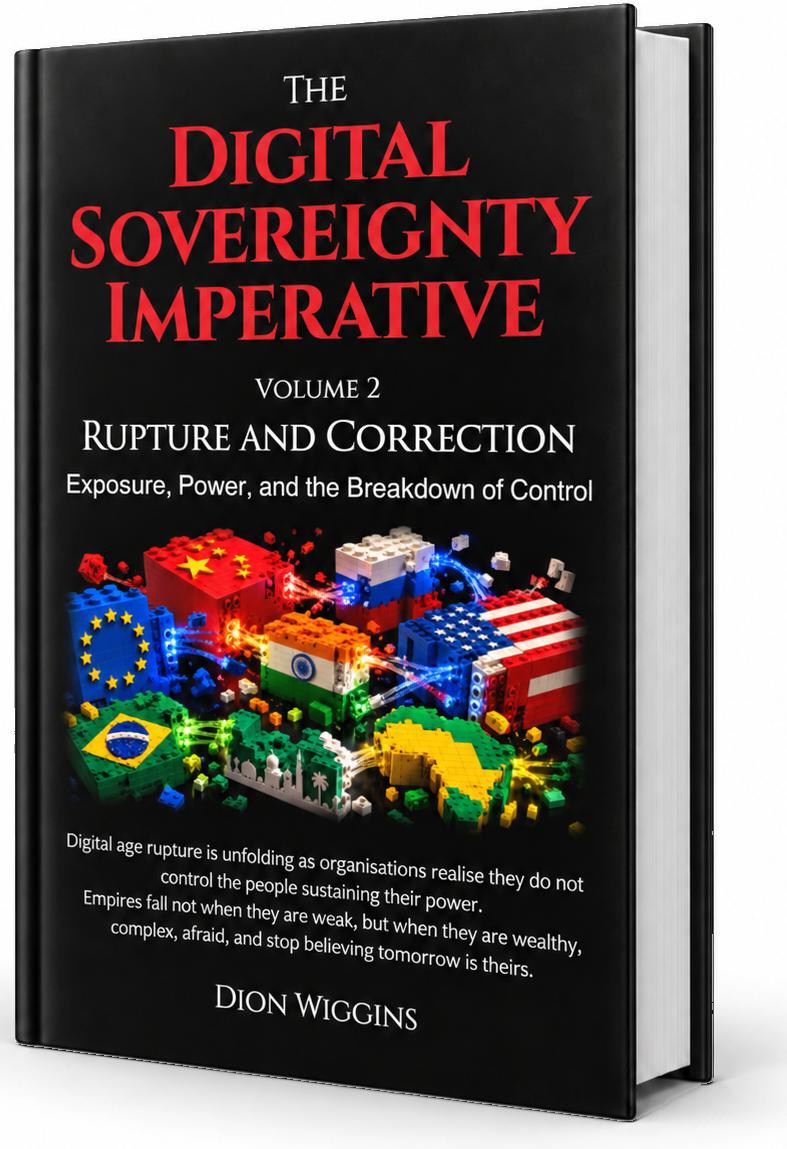
Volume 2: Rupture
Exposure, Power, and the Breakdown of Control
Empires fall not when they are weak, but when they are wealthy, complex, afraid, and stop believing tomorrow is theirs. Volume 2 is the forensic record of that fall in progress, and the evidentiary foundation from which reclamation begins.
The volume documents rupture as a sustained condition rather than a single event, tracing both what is breaking now and what the structural dynamics guarantee will break next. States are building sovereign payment rails, ejecting foreign platforms from government infrastructure, hardening procurement against extraterritorial jurisdiction, and constructing alternative compute and identity architectures. Some succeed. Some fail. Some discover that the dependency they are trying to escape has already hardened beyond reversal.
Volume 3: Reclamation
Taking Back Sovereignty Under Constraint
Dependencies that capture sovereignty will not be surrendered. They must be dismantled through disciplined effort, restoring the authority that decides who holds power and who asks permission. Volume 3 is the engineering manual for that dismantlement, built for institutions that still have a window to act and structured against actors who will defend every layer of control they hold.
Interventions are sequenced by leverage-to-risk ratio, prioritising actions that reduce revocation capacity per unit of capital. Early execution compounds authority. Delay converts exposure into permanent loss.
Who This Is For
Policymakers, strategic planners, political economists, and scholars of technology governance who operate where infrastructure, law, and institutional risk converge. Governments, enterprises, and public institutions committing to long-horizon sovereign cloud and infrastructure arrangements without an operational test of authority survivability. These commitments now shape procurement doctrine, industrial strategy, and infrastructure design across regions, and will govern authority relationships for decades.
Without a disciplined method for identifying where authority is actually exercised, institutions risk mistaking continuity and governance compliance for control. Institutional decisions taken under assumptions of autonomy may instead rest on revocable permission, exposing governance, procurement, and strategic planning to external revocation.
What lies outside these conditions is not digital sovereignty, but an illusion without enforceable authority. The question is not whether sovereignty exists today, but whether it endures when permission is withdrawn. That test begins on the next page.
About the Author
Dion Wiggins is a technology strategist and digital sovereignty analyst with four decades of experience examining digital sovereignty as an operational rather than political condition. As CTO of Omniscien Technologies, he designs and deploys sovereign AI and multilingual language processing systems for highly regulated environments that must function under constraint, withdrawal, or external control pressure.
He founded Asia Online, one of Asia's first Internet Service Providers, helping establish the region's early internet infrastructure, and later served as Vice President and Research Director at Gartner, delivering keynote presentations at its flagship Symposium and speaking on more than 500 stages worldwide.
Wiggins has advised governments, royalty, financial institutions, critical infrastructure organisations, multinational enterprises, and globally operating technology companies on control planes and technological dependency in critical digital infrastructure. His work examines how power is exercised through system design, contractual structure, and computation rather than policy aspiration, informed by experience across Asia, Europe, the Gulf States, and the Americas.